Direct Bookings vs OTAs: How AEO & GEO Help Hotels Break Free
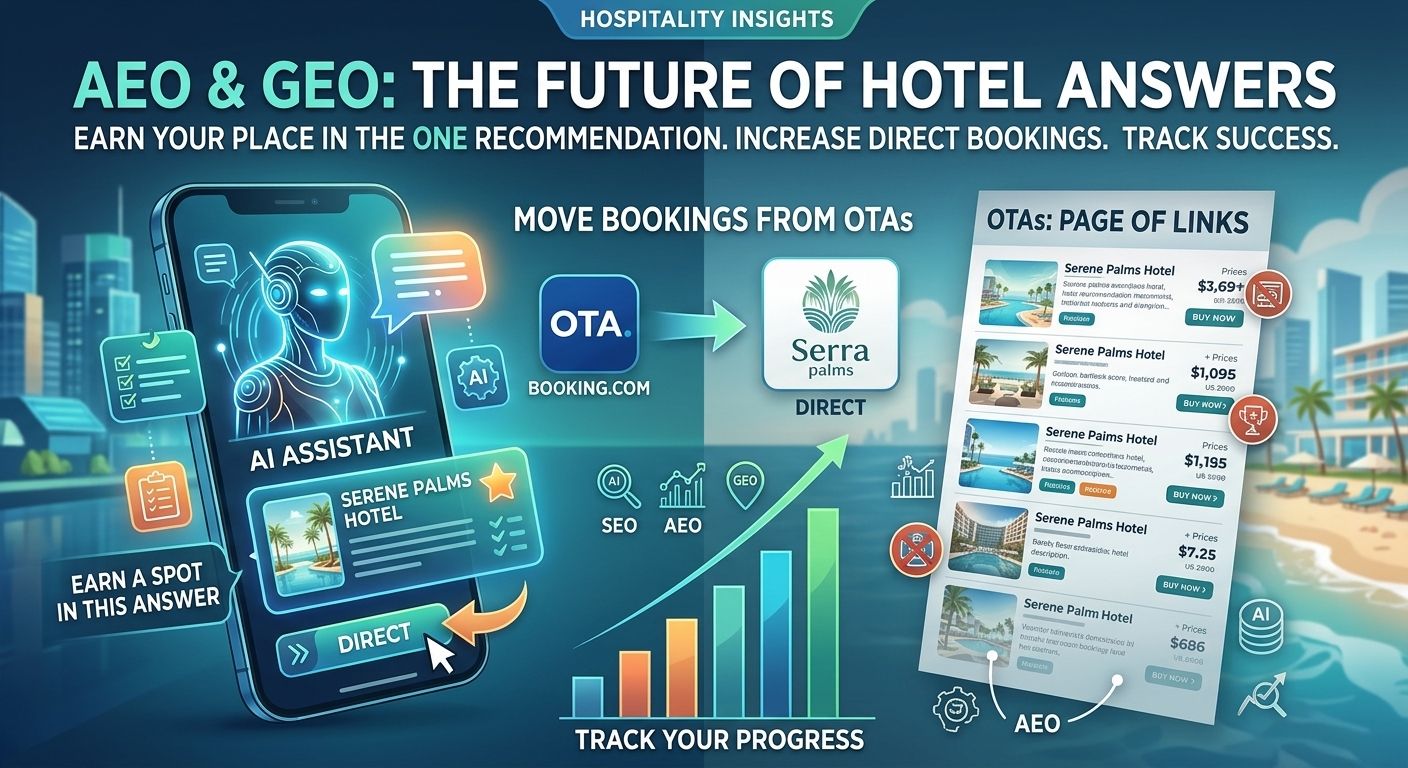
These days, guests often ask an AI assistant where to stay and get a single, tidy recommendation instead of a page of links. This article shows how AEO and GEO can help your hotel earn a spot in that answer, move more bookings away from OTAs, and track your progress without wishful thinking.
The new first search
Picture a guest opening an AI assistant and typing: “best boutique hotel in Lucerne for a couple.” There’s no list of ten blue links to wade through. Instead, they get one neatly written answer that names a handful of properties, usually with a short reason beside each.
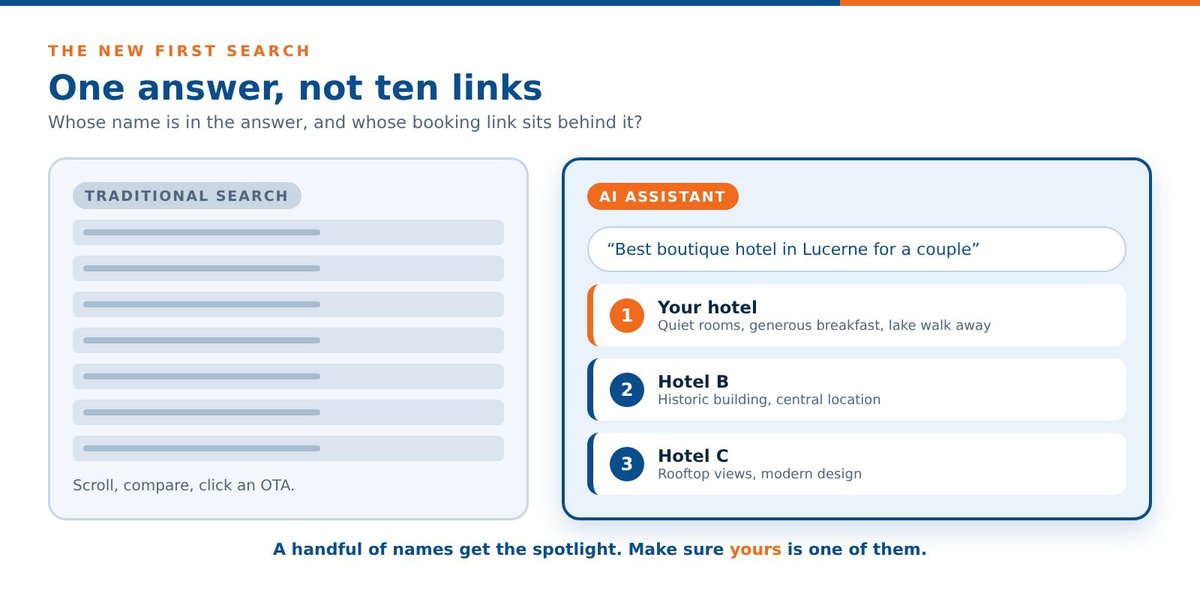
Every hotelier should be able to answer two questions about that moment. Is my hotel named? And when the guest clicks, whose booking link is waiting?
For many independent hotels, the honest truth is that an online travel agency (OTA) shows up first. That’s not luck. OTAs have spent twenty years building the pages, reviews and data that search systems lean on. This article walks through how answer engine optimization (AEO) and generative engine optimization (GEO) give hotels a realistic way to change that balance, without pretending OTAs are going anywhere.
The OTA dependency problem
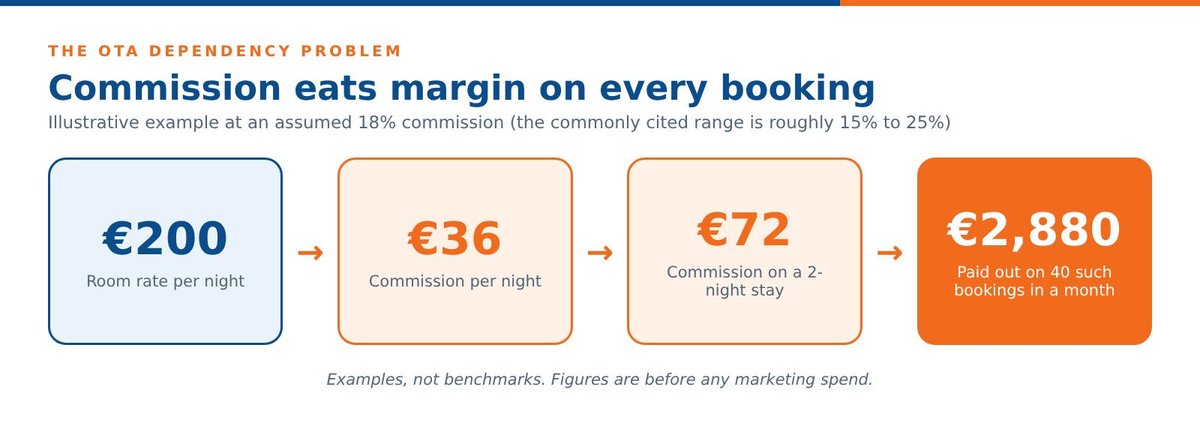
Commission eats margin on every booking
OTA commissions are commonly quoted at roughly 15% to 25% of the room revenue on each booking. Where you land in that range depends on your contract, your market and any visibility programs you’ve signed up for.
A quick example shows how fast it adds up. These numbers are illustrations, not benchmarks.
The guest belongs to the OTA, not to you
The percentage isn’t the only price you pay. When a guest books through an OTA, they usually start a relationship with the OTA first. The OTA holds their contact details, controls the messages they receive, and is best placed to win them back, often for a different hotel. That leaves you with no real chance to build loyalty, offer a reason to return, or find out what the guest was actually looking for.
Direct bookings flip that around. You keep the margin, the data and the conversation. The hard part is being found at the exact moment someone decides, and that moment is increasingly happening inside AI-assisted search.
SEO vs AEO vs GEO in plain language
These three terms overlap, so it helps to think of them as layers that work together rather than separate shortcuts.
- SEO (search engine optimization) helps your pages get crawled, understood and ranked in regular search results.
- AEO (answer engine optimization) makes your facts easy to lift out as a direct answer, like your check-in time or whether you offer airport transfers.
- GEO (generative engine optimization) makes it easier for AI tools to understand your hotel and cite it when they pull together answers from many sources.
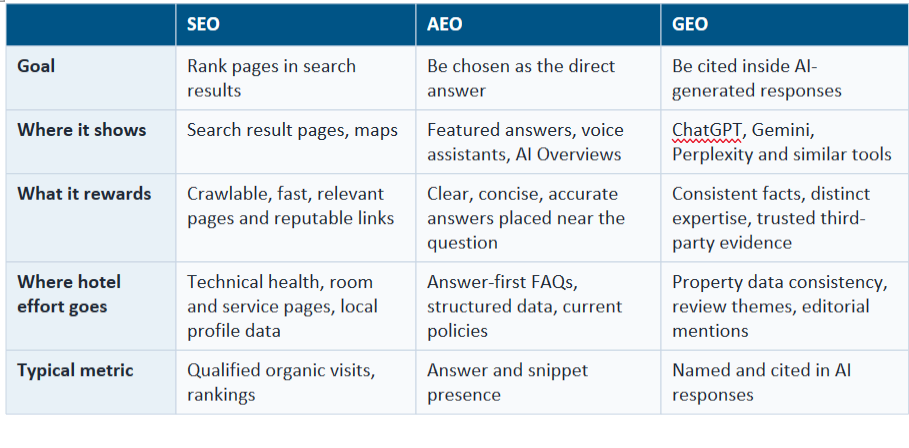
SEO is still the foundation, because search engines and AI tools both need solid pages to crawl and refer to. AEO and GEO build on top of it. They don’t replace it.
How AI engines decide which hotels to mention
Nobody outside these systems can tell you exactly how they work, and they keep changing. What we can say with confidence is that AI-assisted discovery works best when it can find information that is clear, consistent and easy to verify. Three things matter most.
1. Clear, consistent facts everywhere
Imagine your website says check-in is at 2:00 PM, your Google listing says 3:00 PM, and an OTA says 4:00 PM. A system comparing those sources has no way to know which is right. The same goes for breakfast hours, parking, pet policy or amenities. Your website, Google Business Profile and major listings should all tell the same story.
2. Structured data that matches the page
Structured data, such as Hotel (or LodgingBusiness) and FAQ schema, helps machines understand what’s on a page. It has to match what visitors can actually see. Schema can’t make up for missing or inaccurate information, and marking up claims that don’t appear on the page is a mistake to steer clear of.
3. Third-party mentions and, above all, reviews
AI answers draw on far more than your own website. Travel publications, local guides, listing sites and review platforms all feed in. Of these, reviews are often the richest source, because they capture the words real guests use to describe your hotel.
Reviews are the raw material
AI summaries tend to echo what guests say. If dozens of reviews mention quiet rooms and a generous breakfast, those phrases will likely shape how your hotel is described. If slow check-in or street noise keeps coming up, that can surface too.
So reviews aren’t only about reputation. They’re a source of strategy. Aspect-level sentiment scores themes like front desk, housekeeping, breakfast, noise and value separately, rather than squeezing everything into one star rating. It shows you which themes are strongest and repeated most often. Those are the themes AI tools are most likely to repeat, and the ones worth reinforcing on your own pages.
If you’d like a closer look at this approach, read Turning Guest Feedback into Decisions: Introducing SENTEEZ.
The practical playbook
Here are eight actions, in a sensible order. None of them needs a website rebuild.
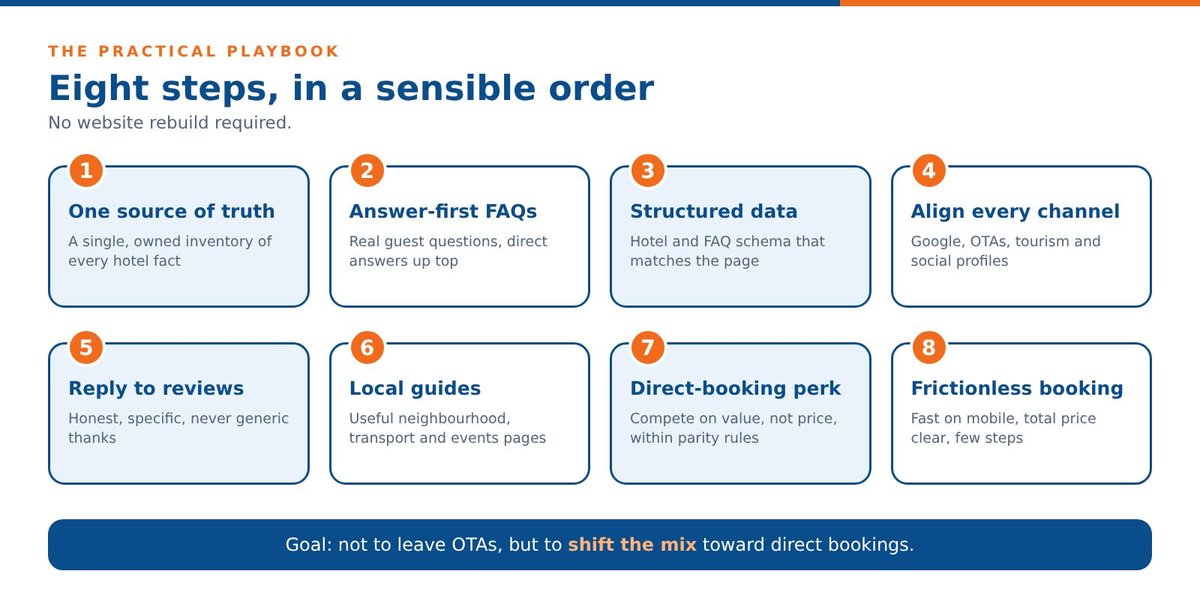
- Create one source of truth. Keep a single inventory of names, addresses, phone numbers, room features, amenities, policies, hours and booking links. Decide who owns each fact and how changes reach every channel.
- Publish answer-first FAQ pages. Pull real questions from reservation emails and the front desk, like airport transport, early check-in or meeting rooms. Lead with the answer in one or two plain sentences, then add the detail.
- Add structured data. Set up Hotel or LodgingBusiness schema, plus FAQ schema wherever the questions are visible on the page. Validate it, and keep it in step with your content.
- Align property data across channels. Check your Google Business Profile, Google Hotel Center feed, OTA extranets, tourism listings and social profiles for mismatches, and fix them. Your own website should stay the final word.
- Respond to reviews thoughtfully. Replies show how you handle problems and let you restate your strengths in your own voice. Tackle recurring themes honestly instead of posting a generic thank-you.
- Build local guides. Write genuinely useful pages on the neighbourhood, transport, events and seasonal planning. They answer questions guests have before booking, and they give AI tools distinctive local content to draw on.
- Offer a direct-booking incentive that survives rate parity. Where your contracts require rate parity, compete on value instead of price: complimentary breakfast, flexible late checkout, a room upgrade subject to availability, or a welcome amenity. Always check your OTA agreements before launching an offer.
- Reduce friction on the booking path. Make room selection quick on mobile, show the total price clearly and keep the steps to a minimum. A guest who found you through an AI answer shouldn’t give up at the final step.
How to measure it
Rankings alone won’t tell you whether this is bringing in valuable demand. Set a baseline first, then track things the same way every time.
A monthly 10-prompt check
Once a month, run the same ten prompts in ChatGPT, Gemini and Perplexity. Note whether your hotel is named, where it appears, and whether your own website is cited. Use the template below, and keep the wording identical each month so the results stay comparable.
Business metrics to track alongside
Branded search volume: how many people search for your hotel by name.
Direct booking share: the percentage of bookings made on your own booking engine.
OTA share trend: whether the proportion of bookings coming through OTAs is falling over time.
Compare all three against your starting baseline, and judge them over months, not weeks.
The funnel is changing
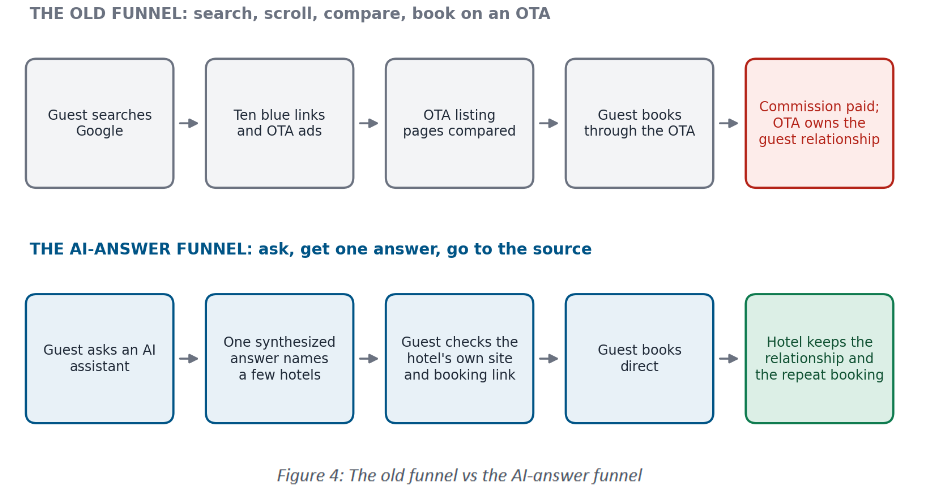
The diagram below sets the traditional OTA-led path next to the AI-answer path. On the second path, your hotel has a chance to be named and linked before the guest ever sees an OTA listing.
What this can’t do
It’s only fair to be upfront about the limits.
- Nobody can guarantee that an AI assistant will recommend a particular hotel. Any provider who promises placement is overselling.
- OTAs still help with discovery, especially for new properties, international guests and quiet periods.
- Results take time. Technical fixes can show up within weeks, but changes in AI citations and direct booking share usually build over several months.
The goal isn’t to walk away from OTAs. It’s to shift the mix, so that more of the guests who already know you, or who find you through search and AI answers, book with you directly.
Frequently Asked Questions
What is AEO?
Answer engine optimization means organizing your information so search engines and voice assistants can use it as a direct answer. For a hotel, that looks like clear, accurate answers about check-in times, amenities, policies and location, placed right next to the question and backed by structured data.
What is GEO?
Generative engine optimization is about making your hotel’s information easier to understand and cite for AI tools that build answers from many sources. It relies on consistent facts, real expertise and trustworthy third-party references, not on a magic keyword.
Can a small hotel compete with OTAs in AI answers?
Often, yes, for specific questions. OTAs are strong on breadth, but a small hotel can be the most accurate and detailed source on its own rooms, neighbourhood and guest experience. Specific, verifiable information and strong review themes give a smaller property a real shot at being named for the searches that fit it.
How long before results show?
Technical fixes and structured data usually appear in search tools within a few weeks. Changes in AI citations and direct booking share tend to build over a few months as sources refresh. Results vary by market, competition and where you’re starting from.