The Hotel SEO Checklist: 25 Practical Fixes to Win More Direct Bookings
Most hotel websites lose direct bookings to problems that are easy to fix: slow pages, thin content, weak local signals and a clunky booking flow. This article gives you a prioritised, tick-box list of 25 fixes in five groups, plus a printable summary table, a five-fix quick-win list and the numbers worth tracking. It also keeps expectations honest: technical fixes typically show results in 3 to 6 weeks, visibility takes months, and nothing guarantees a ranking.
Why your best-located room is booked on someone else's site
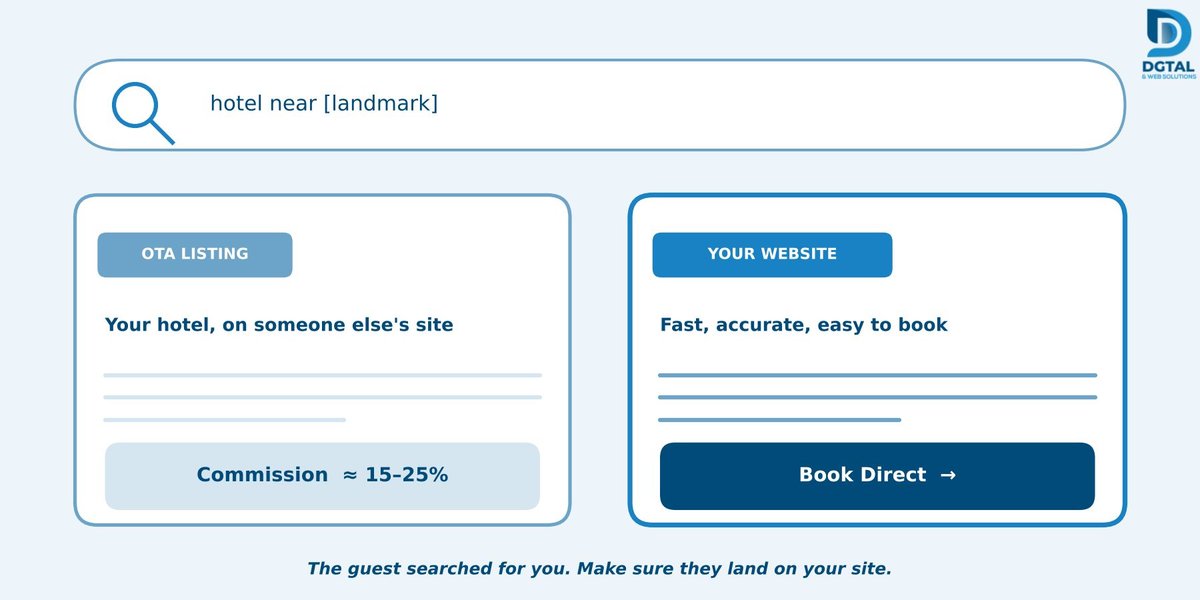
Picture a guest typing your hotel's name into Google, or searching for "hotel near [landmark]." The first result isn't your website. It's an online travel agency (OTA) listing, and that's where they book. That one booking just cost you a commission of roughly 15 to 25%.
Most hoteliers know this happens. Fewer realize how much of it traces back to fixable problems on their own site: pages that crawl, room descriptions copied from an OTA, weak local signals and a booking flow that makes guests work far too hard.
The key point: most of the fixes below are cheap, and several can be done in a week. This checklist puts 25 of them in order, so even a small team can work through it without guessing where to start.
How to use this checklist
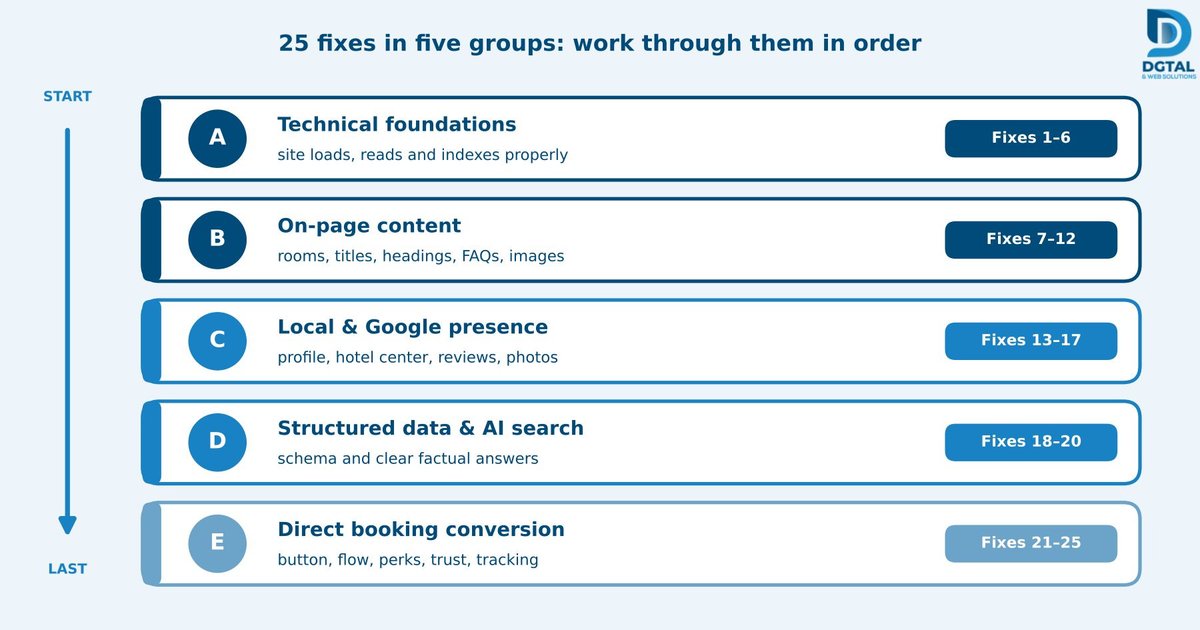
Work through the groups in the order shown. Foundations come first and conversion comes last, because there's no point polishing a booking button on a page Google can't reliably load.
- Give each group an owner. A name beside each group matters more than a perfect plan.
- Tick items off in a shared sheet. The printable table near the end is built for exactly this.
- Set expectations early. Technical fixes typically show results in roughly 3 to 6 weeks, while visibility gains take months. Nothing here guarantees a ranking.
We've kept definitions short on purpose. If you'd like the concepts behind SEO, AEO and GEO first, read our earlier post, Understanding SEO, AEO, and GEO for Modern Hospitality. This piece is the practical how-to.
Group A: Technical foundations (fixes 1 to 6)
If search engines struggle to load, read or index your site, nothing else works as well as it should. Start here.
| Done | No. | Fix | what to do and why? |
|---|---|---|---|
| . | 1 | Fix broken links and redirect chains | Run a crawl with a tool such as Screaming Frog or your SEO platform. Broken links waste visitors' time and redirect chains slow pages down, so fix the worst ones first. |
| . | 2 | Make the site mobile-first | Make the site mobile-first Most guests browse on their phones. Test your key pages and the booking flow on real devices, not just in a desktop preview. |
| . | 3 | Improve page speed | Compress images, turn on caching and remove scripts you don't need. Oversized photos are the usual culprit on hotel sites, so start there. |
| . | 4 | Use HTTPS everywhere | Every page, including the booking engine, should load securely. Browsers warn guests away from pages that don't. |
| . | 5 | Submit an XML sitemap and check indexing | Submit the sitemap in Google Search Console, then confirm your room, offer and location pages are actually indexed. |
| . | 6 | Fix duplicate pages and set canonical tags | Print versions, tracking-parameter URLs and old page copies can compete with each other. Canonical tags tell Google which version counts. |
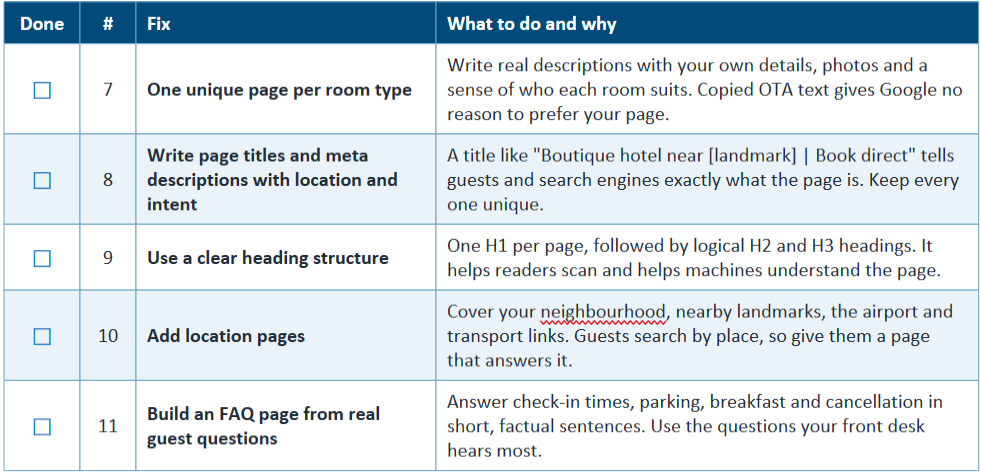
Group B: On-page content (fixes 7 to 12)
Content is where an independent hotel can beat an OTA. You know your rooms, your street and your guests far better than a template listing ever will.
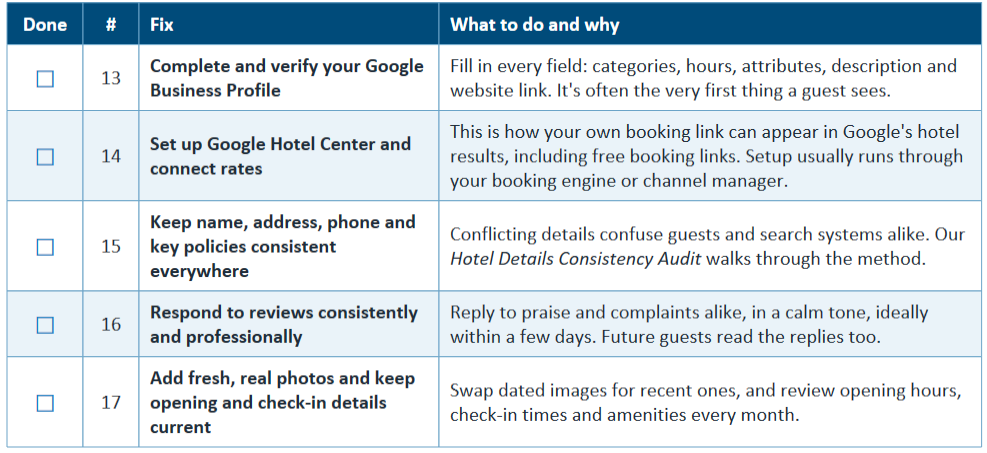
Group C: Local and Google presence (fixes 13 to 17)
Many guests meet your hotel on Google before they ever reach your website. These fixes make sure what they see there is complete and correct.
Group D: Structured data and AI-search readiness (fixes 18 to 20)
Guests increasingly ask AI assistants where to stay. These fixes make your information easier to read and to quote.
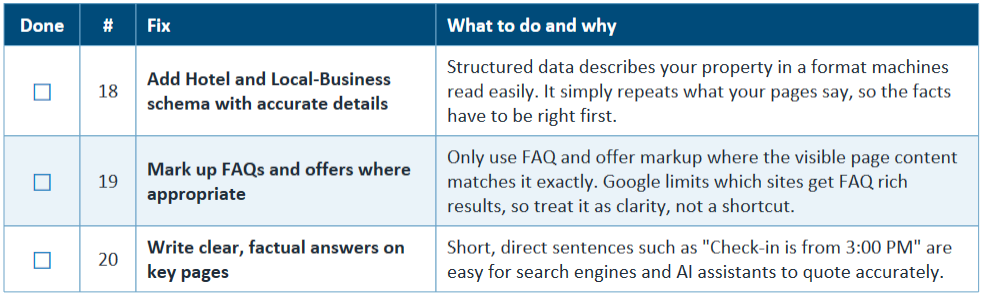
A word of caution. schema can't fix wrong information, and nobody can guarantee that an AI assistant will cite your hotel. These steps remove obstacles. They don't promise placement.
Group E: Direct booking conversion (fixes 21 to 25)
Once guests can find you and trust what they read, make it easy for them to book.
| No. | Fix | What to do and why |
|---|---|---|
| 21 | Make "Book Direct" visible on every page | A clear button or bar in the header, on mobile as well as desktop, so a ready guest never has to hunt for it. |
| 22 | Shorten the booking flow and test it on mobile | Count the steps from room choice to confirmation and cut any you don't need. Then book a test stay on your own phone. |
| 23 | State direct-booking perks clearly | Flexible cancellation, breakfast, late check-out or a member rate give guests a reason to book with you instead of an OTA. |
| 24 | Add Trust Signals | Show real reviews, plain policies and secure-payment cues near the booking button, where doubt is highest. |
| 25 | Track Coversions | Set up analytics goals and booking-engine events so you can see which pages and sources lead to bookings. |
What to do first: the 5-fix quick-win list
If you only have a week, start with these five. They're cheap, visible and tend to help every other fix.
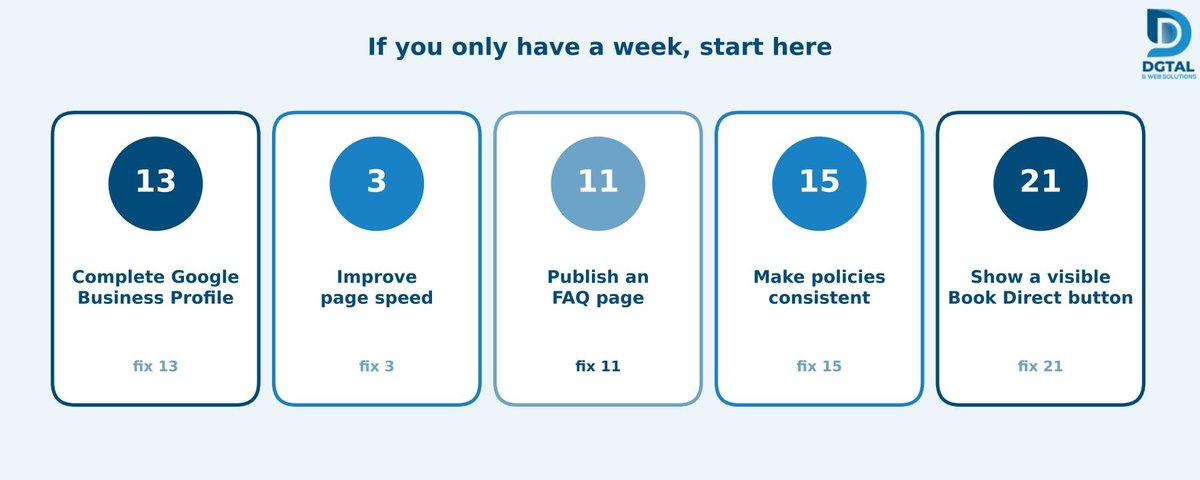
- Complete your Google Business Profile (fix 13). It's free, and it's often a guest's first look at you.
- Improve page speed (fix 3). Compressing photos is usually the fastest win.
- Publish an FAQ page (fix 11). Answer the five questions your front desk hears most.
- Make policies consistent (fix 15). Check-in time, check-out time and cancellation terms should match on every channel.
- Show a visible Book Direct button (fix 21). Check it on a phone, on every page.
Measuring progress
Pick a handful of numbers and review them monthly. Compare quarter to quarter, because month-to-month movement is noisy.
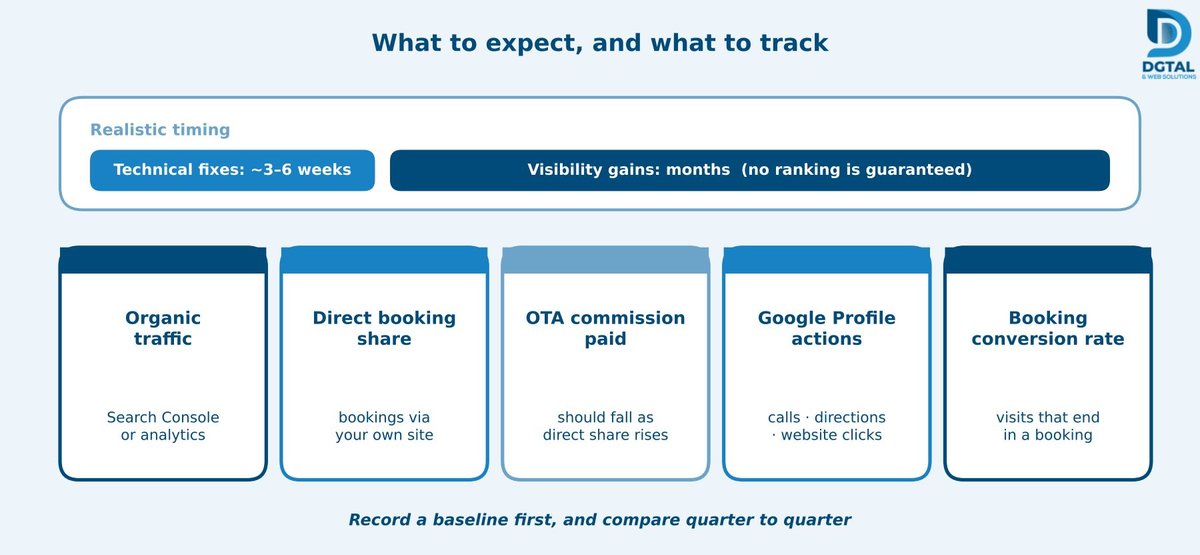
- Organic traffic to the website, from Google Search Console or analytics.
- Direct booking share, the proportion of bookings that come through your own site.
- OTA commission paid, which should fall as your direct share rises.
- Google Business Profile actions: calls, direction requests and website clicks.
- Booking conversion rate, the share of site visits that end in a booking.
Record a baseline before you begin. Without one, an improvement is only a feeling.
Conclusion
Direct bookings are rarely won by one clever trick. They're won by lots of small, fixable things done consistently: a fast site, honest room pages, accurate Google details and a booking button that works on a phone.
Start with the quick wins, give each group an owner and review your numbers every month.
Want a second pair of eyes? DGTAL & Web Solutions offers a free 10-point Visibility & AEO Audit, delivered within 48 business hours. You can also book a free consultation to talk through your priorities
Frequently Asked Questions
How long does hotel SEO take to work?
Technical fixes typically show results in roughly 3 to 6 weeks. Gains in visibility usually take months, and nobody can guarantee a ranking.
2. Which fixes should we do first?
Start with the five quick wins: a complete Google Business Profile, faster pages, an FAQ page, consistent policies and a visible Book Direct button.
3. Do we need a developer to work through the checklist?
Not for all of it. Group B, most of Group C and parts of Group E are content and settings tasks that your marketing or revenue team can handle. Speed, redirects and schema usually need web or IT support.
4. Will this checklist get us recommended by AI assistants?
It makes your information clearer, more consistent and easier to quote, but no one can guarantee AI citations. Think of it as removing obstacles, not buying placement.