The Hotel Details Consistency Audit: Why Wrong Check-In Times Destroy Direct Bookings
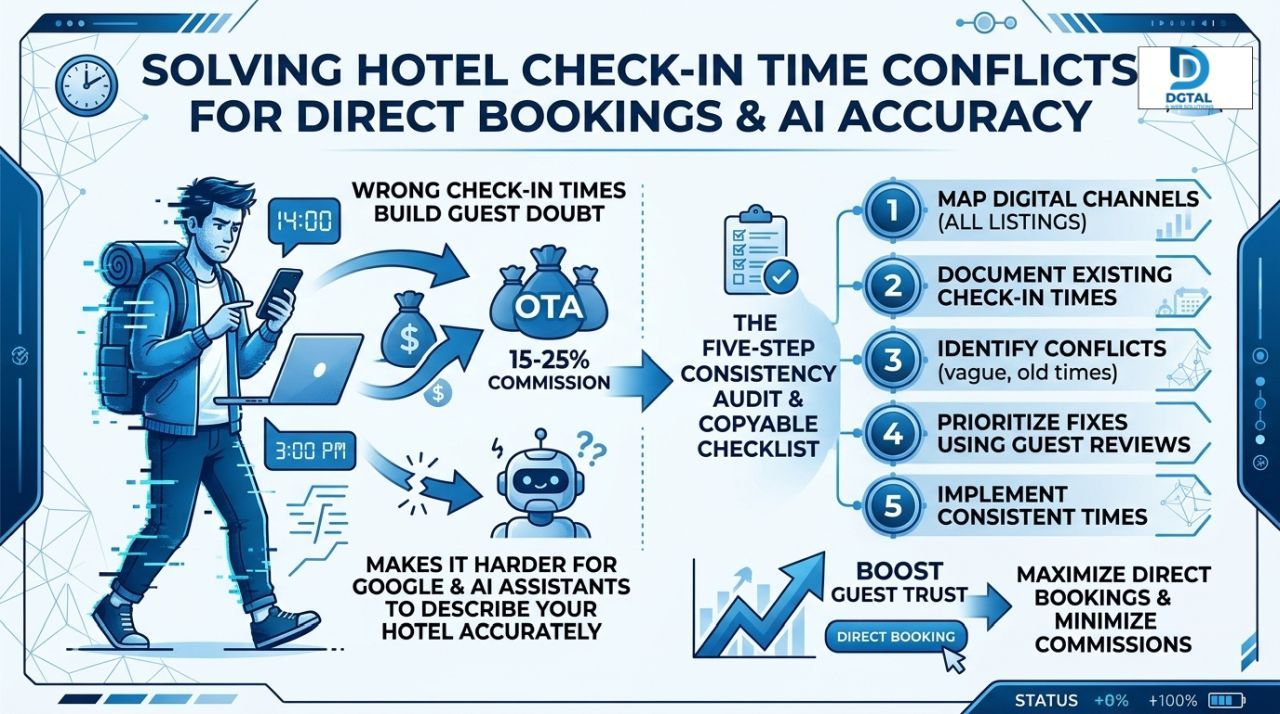
Wrong or conflicting check-in times look minor, but they make guests doubt a hotel and push them toward OTAs that charge 15 to 25% commission. The same conflicts make a hotel harder for Google and AI assistants to describe accurately. This article explains the problem and gives hotels a five-step consistency audit with a copyable checklist. It also covers how to use guest reviews to prioritise fixes and which results to expect, without promising any AI placement.
A small mistake with a real cost
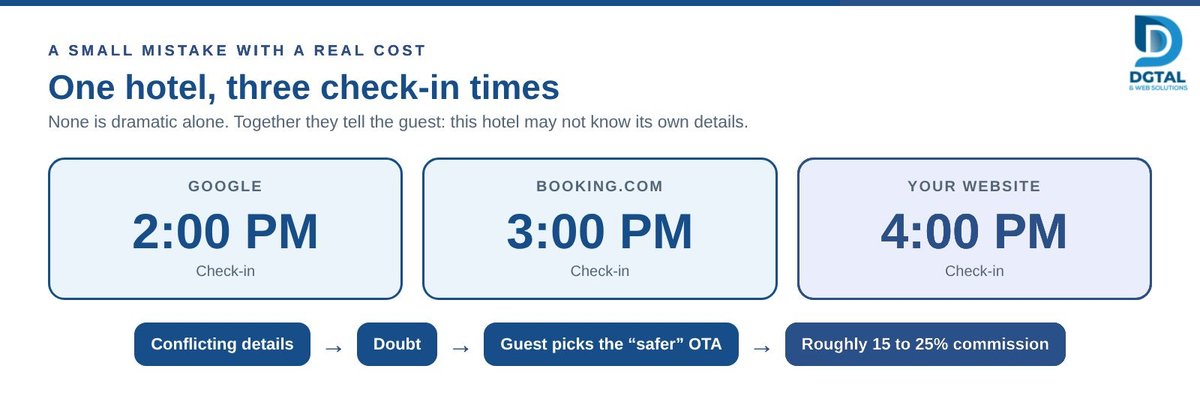
Imagine a guest comparing hotels for a weekend away. On Google, your check-in time is 2:00 PM. On Booking.com, it’s 3:00 PM. On your own website, it says 4:00 PM. None of these is a disaster on its own. Put together, though, they whisper something to the guest: this hotel might not know its own details.
That little doubt does the most damage at exactly the moment you want the guest to book direct. Someone who isn’t sure about your website will often go with whichever channel feels safer, and that’s usually an online travel agency (OTA) that charges a commission of roughly 15 to 25% on the stay.
In this article, we’ll look at why basic facts like check-in time carry more weight than most hotels realise, how conflicting information can hurt you in both guest trust and search visibility, and how to run a simple consistency audit that fixes the problem at its source.
Why check-in time is never just a detail
Check-in time can look like admin, but guests read it as a sign of reliability. When it’s wrong or inconsistent, three things tend to follow.
- Guests hesitate at the booking decision. People planning around flights, children or a late arrival build their day around this number. If they find two different answers, they have to stop and work out which one is true.
- Your front desk absorbs the friction. A guest turns up at the time shown on the channel they booked through, and the room isn’t ready. The conversation starts with an apology instead of a welcome.
- Reviews pick it up. Check-in confusion is a common complaint in public reviews, and it colours how the rest of the stay is read.
It becomes a chain reaction: unclear details reduce trust, reduced trust pushes guests toward OTAs, and OTA bookings cost you commission that a direct booking wouldn’t.
How inconsistent details hurt you in search and AI answers
Guests don’t rely on just one source anymore. They check Google, ask AI assistants like ChatGPT, Gemini and Perplexity, and read OTA pages and reviews. These systems pull information from many places, and when a business’s basic facts disagree across those places, it gets harder for them to give a confident answer about that business.
Accurate, consistent information in places like Google Business Profile and Google Hotel Center is a foundation for being found and described correctly. It isn’t a trick.
A realistic note on limits. Nobody can guarantee that a hotel will be recommended or cited by an AI assistant, and any agency promising that deserves a few questions. Structured data (schema markup) can’t fix wrong information either. It only labels what your pages already say, so if the underlying facts are inconsistent, the markup simply labels the inconsistency. Fix the facts first.
Where the conflicts hide
Hotels usually have more places holding their details than anyone has written down. Information gets entered once, a policy changes later, and a channel or two never gets updated. The table below shows the most common locations and who’s best placed to own each one.
Details worth checking in every channel: check-in and check-out times, cancellation policy, parking, breakfast hours, pet policy, amenities, and contact details.
The Hotel Details Consistency Audit: a step-by-step method
You don’t need special software to get started. All it takes is a list, a decision and a routine.
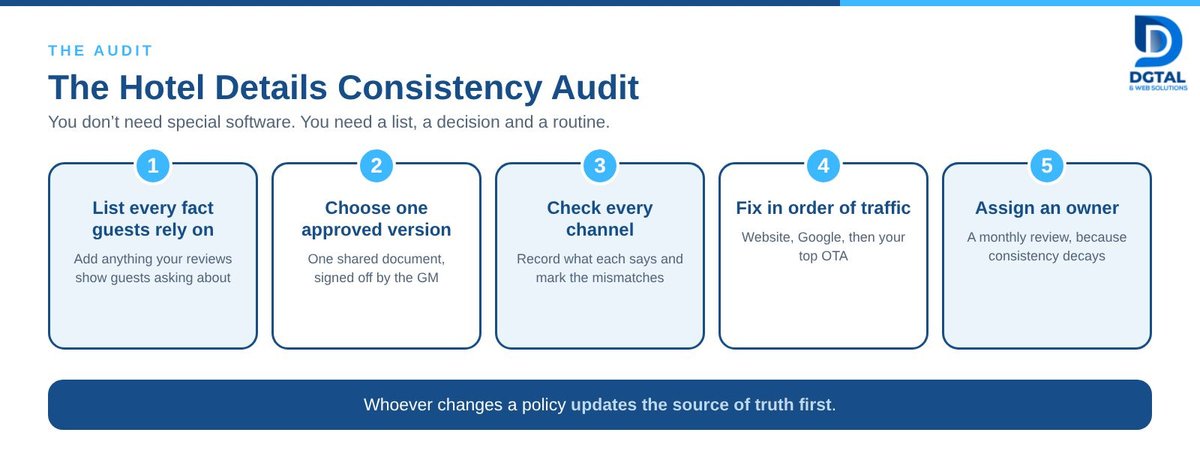
- List every fact guests rely on. Start with the details above, then add anything your reviews show guests asking about.
- Choose one approved version of each fact. This is your single source of truth: one shared document, signed off by the GM, that everyone updates first.
- Check every channel against it. Work through each source in the table, note what it currently says, and mark the mismatches.
- Fix errors in order of traffic. Begin with your website, Google Business Profile and the OTA that brings in the most bookings, then work your way down the list.
- Assign an owner and a monthly review. Consistency fades over time. Whoever changes a policy should also update the single source of truth and trigger a re-check.
A quick checklist you can copy:
- Is the check-in time identical on our website, booking engine, Google profile and every OTA?
- Does the same apply to check-out time and our cancellation policy?
- Do confirmation emails and printed welcome material match the website?
- Has someone been named as owner for each channel?
- Is there a recurring date in the calendar to re-run this check?
Use guest reviews to find what to fix first
Reviews show you which inconsistencies guests actually notice. Search them for words like check-in, early arrival, parking, breakfast and policy. If the same confusion keeps coming up, that’s where to start.
This is where department-level review analysis comes in handy. SENTEEZ, the guest-intelligence product from DGTAL & Web Solutions, groups public reviews by department, such as front desk, housekeeping, F&B and room comfort, so a hotel group can see which themes repeat at which property. Star ratings alone hide this.
One caution applies to any tool of this kind: automated sentiment is there to support human judgment, not replace it. Read the source comments before you act on a trend.
What to expect after the fixes
Results tend to arrive in stages. Treat these timelines as typical, not promised.
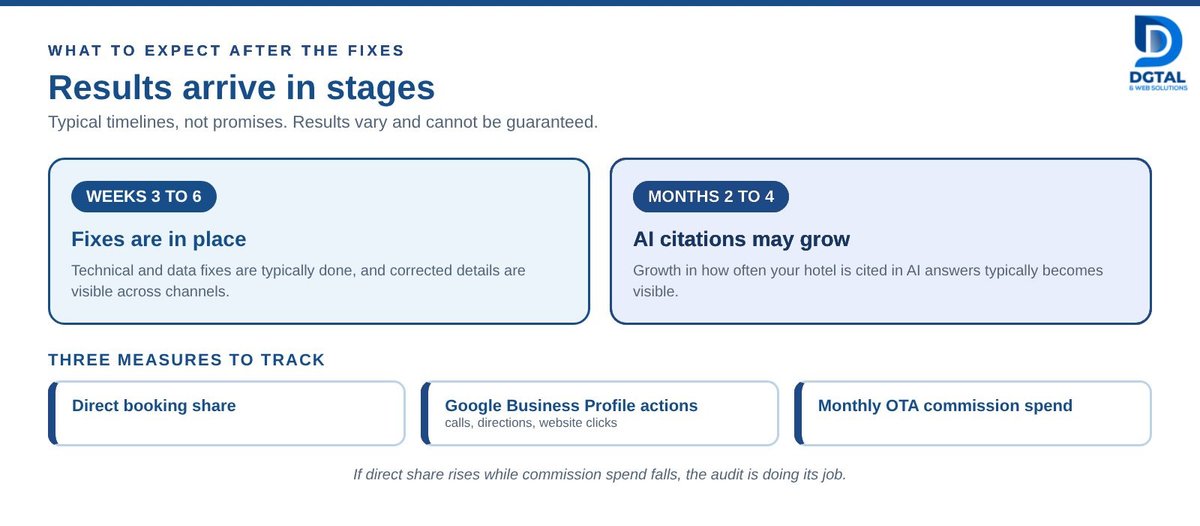
Weeks 3 to 6: technical and data fixes are typically in place, and corrected details are visible across channels.
Months 2 to 4: growth in how often your hotel is cited in AI answers typically becomes visible, though results vary and can’t be guaranteed.
To judge whether the work is paying off, track three measures: your direct booking share, actions on your Google Business Profile (calls, direction requests and website clicks), and your monthly OTA commission spend. If direct share goes up while commission spend comes down, the audit is doing its job.
Conclusion
Accurate details build trust, trust supports direct bookings, and direct bookings keep commission in your own revenue. A wrong check-in time looks minor, but it sits right at the point where a guest decides who to book with.
The audit takes only a few hours to start, and most hotels find mismatches they never knew existed.
Want a second pair of eyes? DGTAL & Web Solutions offers a free 10-point visibility audit, delivered within 48 business hours. You can also book a free consultation to talk through your direct-booking strategy.
Frequently Asked Questions
Why does a wrong check-in time affect direct bookings?
Guests treat basic details as a sign of reliability. When your website, Google and the OTAs show different times, some guests hesitate and book through an OTA instead, which usually costs 15 to 25% in commission.
Where should a hotel check for inconsistent details?
Check your website and booking engine, Google Business Profile and Google Hotel Center, every OTA listing, your social profiles and directories, and your confirmation emails and printed material. Compare check-in and check-out times, cancellation policy, parking, breakfast hours and contact details.
Can fixing these details guarantee that AI assistants will recommend my hotel?
No. No one can guarantee placement in ChatGPT, Gemini, Perplexity or Google results. Consistent, accurate information removes an obstacle and makes your hotel easier to describe correctly, but it is not a promise of recommendations.
How often should we run the consistency audit, and how long until we see results?
Re-check monthly and whenever a policy changes. Technical fixes typically take about 3 to 6 weeks, and growth in AI citations typically shows in months 2 to 4, though results vary.